Op-Ed: A Fire Burns in Crown Heights

An Essay on Religion, Modernity and Pizza
We live in a dual culture - pulled by the Jewish, Chassidic, and uniquely Lubavitcher traditions that bind us, we also seek on some level to integrate into the society around us. Our use of innovations in technology, our homes, and even our clothes, are all the result of the modern world's influence on our lives. [Note to those that take issue with the belief that any modernity has seeped into our Lubavitcher meta-culture: Our mode of dress - be it the short jacket, the choice of a more modern fedora over the more traditional Russian kasket, or even the relatively modern design of the Kapote (based on the Victorian Prince Albert frock) are all signs of our organic adaptation to the modern world]. The calls of modern life offer a lot of potential. They also give room to incredible danger. It is the tension of spanning this spiritual chasm that we must address if we are to remain viable as a group.
It is my contention that in no other season is this dichotomy embodied then the Summer months. In chassidic thought, the increased revelation of sunlight and warmth in the summer is the physical manifestation of the greater divine revelation being showered upon the earth. As the Torah teaches, however, the greater room for spiritual potential and growth, the greater the manifestation of the impure. To be frank: The revelation of the shemesh havaya, the G-dly power of the summer, brings to a very disturbing trend of a rather different revelation on the streets of Kingston.
This so called tznius problem has been debated across numerous forums. It is a source of shame to our community and a point of contention among us.
This past Friday, a self-appointed group of yungeleit and concerned members of the Crown Heights community decided to act on their frustration with the lack of decorum and modesty in this community. Having, to some degree of success, protested various breaches of tznius in the past, they are now focusing their ire on what they consider to be the latest crack in the moral fiber of our community: The restaurant Basil.
Let me preface my words with a few important points to take into consideration before analyzing the relative merits and flaws of this ad-hoc committee's goals:
Eating in a restaurant is not a very chassidishe thing to do: No matter how we feel about the relative application of avodas ha'iskafiya - the suppression of our base tendencies - in our current generation, I believe we can all concede that it isn't the most chassidic act in the world to revel, to koch, in good food. What is more, no matter how fine the hashgacha any restaurant may have, it will never come close to the standards of practice in a truly exacting and frumme home. Thus, for the sake of this article, we can safely assume that truly chassidishe yidden shouldn't eat out.
Moreover, a restaurant, as with any other establishment in a community, ought to respect the standards and mores of the community. Thus an establishment that plays non-Jewish music or kol isha, and is staffed by people who dress and act inappropriately, ought to do its utmost to respect said standards and cease such objectionable actions.
In any event, I consider myself somewhat of a free-agent. I try to remain balanced in my opinions, take all sides into account, and base my conclusions on what is truly right and reasoned. Interested in the discussion that would take place between the management of the restaurant and the yungeleit, I went to Basil.
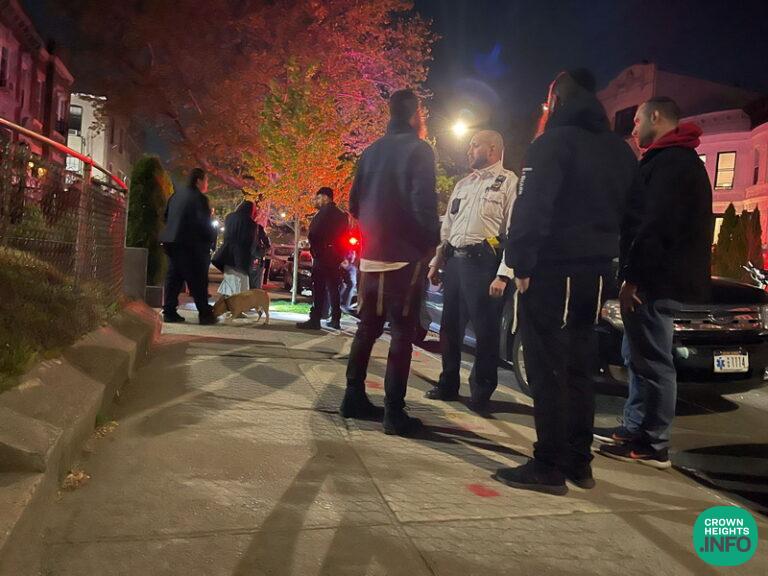
What I found was utter chaos on the street corner in front of the restaurant. The discussion was heated - with the manager and another employee surrounded by close to a dozen yungeleit.
During the course of the talk, it became clear that one of ba'al habatim assisting in the protest had gone to the restaurant the previous evening and used a salacious and unsavory term to describe the manager, the waitresses and the patrons (some of whom later turned out to be visiting from Flatbush).
I asked the ba'al habayis if, with all forgiveness to my questioning his actions, he honestly felt that his comments were in line with the Rebbe's directives and if they would prove effective in changing the situation. He told me that he had previously agreed that such negative comments were not in line with the Rebbe's belief of doing things b'darkei noam ub'darkei shalom - in a pleasant and peaceful manner - but a kolel yungerman present at the protest had found such methods effective in the the past.
This yungerman, who is one of the ringleaders of the push to cleanup Crown Heights, is known for approaching ladies on the street conducting themselves in a fashion not fitting for a bas yisroel and clearly letting them know of their wrongdoings.
Approaching the ringleader, I was told that I was standing in the way of their success, that my presence (and dare I say - look, as my clothes were in many ways similar to theirs - I was wearing my kapote in honor of 13 Tammuz) was causing a chilul hashem. What is more, I was akin to those who fight against shleimus ha'aretz.
I was shocked - here was a man in the middle of a heated verbal exchange with a fremde lady, arguing in front of the non-Jewish waitresses, secular Israeli cooks and non-Jewish neighbors on the street - and I was the one making the chilul hashem!
When I asked him to please clarify which group that fights against shleimus ha'aretz I was comparable to - if it was the liberal pro-Palestinian J Street, the Ahmadinejad-kissing Neturei Karta, or the PLO itself - he became even more incensed.
Other members of the group complained of the chilul hashem I was causing - or gave me all around dirty looks.
The police were called and the group dispersed. I never found out the exact reasons they chose to protest Basil, besides that it represented a move away from sanctity found in the communities of Monsey, Williamsburg, Boropark and “even” Flatbush. In a private conversation, a member of the group had previously relayed to me his disdain for fancy restaurants. In his belief system, they are uniquely un-Jewish - lacking the so called “yiddishe ta'am v'ruach.” If his opinion reflects that of the entire group, then the protest was merely a proxy war on what they consider to be modernity in general.
No matter what their reason may be, something about the actions of these well-meaning, albeit misguided, members of the kolel is very disturbing. While certain issues they have crusaded against have ended positively - I posit that such success was due to the general unimportance of the issue to the one being protested. The fact that the barber removed the television from his shop is very much rooted in the lack of importance the TV plays in his life and business.
The decision, however, to make comments to women parading down the street - however deplorable their actions and dress - can almost never be justified.
It is a horrible practice - one that can unwittingly cause immense, unforeseen, and irreversible damage.
Let us imagine that our young zealot sees a lady walking down Kingston in clearly inappropriate dress - she's flaunting herself in the most degrading manner possible. Our zealot mutters his comment under his breath and then hastens his step to avoid dealing with her any further.
If we are to follow these words further - after they have left his mouth and long since he has returned to his home - what has become with this lady?
Is she shaken? Perhaps she becomes agitated. How will that affect her family relationships? Will it prove to be a positive force in her shalom bayis?
What of a single girl? Will it encourage her to improve in her personal spiritual growth? What if she is on the edge? Her dress is obviously not in line with someone scrupulous in her daily observance of Torah and Mitzvos . . . Will this girl decide to return to the fold because some strange man insulted her and scurried down the street? Or will it push her further away?
It is all too apparent that these comments will have little positive outcome:
1. They are harsh and exclusionary to those on the edge of observance.What is more curious about the actions of these zealots - with all of their desire to fix the bleeding wounds of our community (and the wounds are indeed there), they make little effort to reach out to the “at risk” bochurim. If these yungeleit are truly worried about the community and wish to stop all breaches of decorum and halacha - why don't they mutter comments under their breaths to the youth that are seen with trimmed beards (a biblical prohibition(!) according to the Tzemach Tzedek and thus halachicaly binding on everyone who considers himself a Lubavitcher) and shorts?
2. They are hardly positive and pleasant in their nature. It is doubtful they come from a place of love.
3. We can therefore conclude: They will have little positive affect on the lady.
Could it be that women happen to be easier targets? A woman, after all, is less likely to protest and what is more, prove less of threat if truly incensed.
Dear reader - let me ask you another question. Even if we are to take for granted that verbally protesting the dress and conduct of strangers in our community is a valid and positive action, wouldn't it make sense according to Shulachan Aruch that men speak to men, and women to women? If these well meaning members of our community must make a statement - why don't they have their wives speak to the offending women?
The answer to these questions is clear: Such actions that are not done from a place of compassion and caring for the one receiving the rebuke are clearly inappropriate. Not only do they fail to succeed in drawing the person closer, they often push her farther away. The decision to insult those breaking with halacha comes purely out of a desire for self-preservation, ani es nafshi hitzalti. What is more, like the tradition of Mussar as opposed to Chassidus, it seeks to cure the symptoms of a deeply rooted disease, instead of fighting the sickness itself.
Lest my words be skewed in any way as a tacit approval of the dress currently in vogue in our community, let me be clear: The current levels of tznius among even relatively frum and well-acclimated members of the community are atrocious. There is no excuse for the laxity that has become so common among us!
Crown Heights currently finds itself in spiritual malaise. The generation, my generation, brought up in the shadow of 27 Adar and 3 Tammuz finds itself at loss to address the enormity of the situation at hand. People are confused and frustrated - forced to choose between a myriad of often contradicting beliefs and viewpoints - with no one able to truly say with confidence that they have the solution. People are apathetic to the fighting . . . they just want to live. So they do live - in a makif. Without a solid base and clear understanding of the Halachic does and don'ts of yiddishkeit, everything is filed under some vague grouping of chassidishkeit. There is no longer an intellectual and emotional commitment to the matters of tznius - so seemingly small breaches are not felt to be the abrogations of halacha that they are.
There is a serious breakdown in chinuch. Too many of us no longer practice religion out of complete and utter conviction towards the divine truth, but live a life of happenstance. Judaism, Chassidism and Chabad are all groups with which we happen to associate ourselves. The American stress on the individual has destroyed the traditional belief in community. “Accept me for who I am!” they cry. There's a complete disconnect between what is done and what is believed. Just as the Alter Rebbe speaks of person sinning, under the belief that the deed will not separate him from G-d - odenu b'yahaduso - the parade down Kingston stems from the misconstrued belief that one can dress provocatively and still be whole in one's chassidishkeit.
Perhaps then, in light of all the above, I can humbly suggest a possible solution toward ending the insanity on both sides. In the early years of the nesius, the Rebbe encouraged the bochurim to be mashpia on the local Jewish store owners and encourage them to to close up shop on Shabbos. Slowly, by means of building a personal relationship and showing that their message came from a place of love (d'varim hayotzim min halev) the bochurim were able to convince some of the storekeepers to close for Shabbos. Everyone has someone in their life that they are able to be mashpia on - be it a friend, classmate, camper or neighbor. If we approach those that we love - men to men, women to women - and invest time energy and patience, the results will surely be abiding.
This Op-Ed reflects the views of its author. It does not necessarily reflect the views of CrownHeights.info or its Editors.
Any reader that wishes to make his or her voice heard, on any topic of their desire, is welcome to submit his or her Op-Ed to News@CrownHeights.info.


1. ten wrote:
i agree!I think this is the best op-ed yet on any chabad sites!